

There’s a moment almost every sim racing beginner experiences.
You’re watching an F1 race or seeing clips from iRacing, and suddenly you spot someone sitting in a complete racing rig, going wheel-to-wheel through Monza. Instantly, the thought appears:
“I want that setup.”
Then you start searching for a racing simulator setup and suddenly run into wheel bases, pedals, cockpits, load cells, shifters, handbrakes, mounts, and dozens of recommendations pulling in different directions.
The good news is that getting started is much simpler than it looks.
If you’re in the UAE and building your first setup, this guide explains what each component actually does, what matters most early on, and what you should buy first without overspending or upgrading twice.
The Four Parts of Every Sim Racing Setup
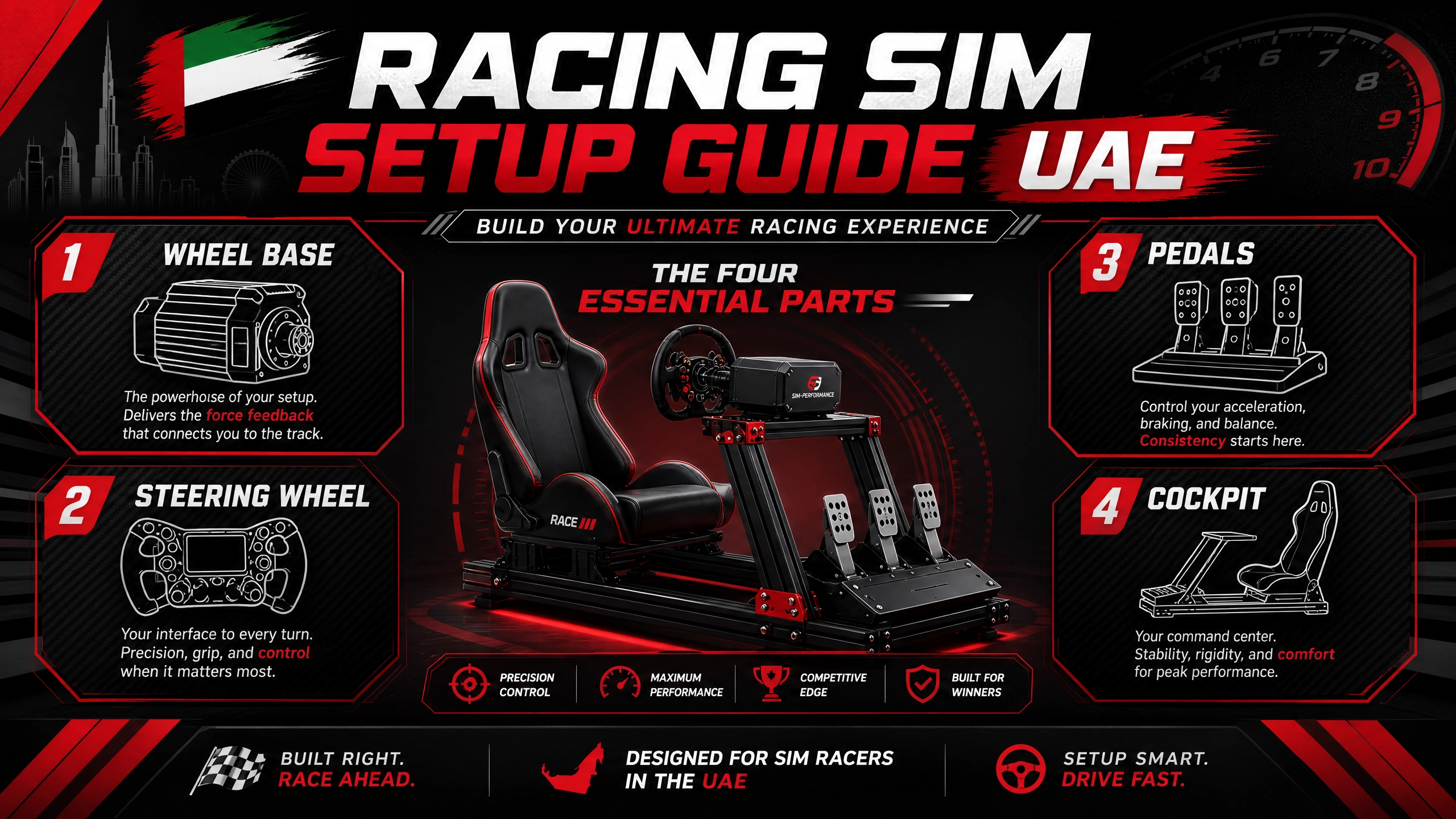
Every racing setup, from a desk-mounted starter wheel to a full cockpit rig, is built around the same essentials.
Understanding these four components makes buying decisions much easier.
Wheel Base
The wheel base is the motor unit mounted to your desk or cockpit.
This is what creates force feedback, the resistance and movement you feel through the steering wheel when:
- Losing grip
- Driving over kerbs
- Braking aggressively
- Feeling changes in road surface
This is usually the most important part of your setup, especially when using a direct drive wheelbase, and where most of your budget should go.
Steering Wheel
This is the rim you physically hold, allowing sim racers to feel the precision of driving real race cars.
Most bundles include one wheel, but many sim racers eventually switch between wheel styles depending on what they drive:
- Formula-style wheels
- GT wheels
- Rally wheels
It isn’t essential early on, but it becomes more enjoyable as your setup grows.
Pedals
Pedals connect either to the wheel base or directly to a PC.
Starter pedals usually rely on springs for resistance.
Higher-end pedals use load cell technology, which measures braking pressure rather than pedal travel.
Why does that matter? Because braking consistency improves dramatically. For many sim racers, pedal upgrades eventually make a bigger difference than wheel upgrades.
Cockpit or Mounting Solution
Everything needs a stable place to sit.
Your options generally include:
- Desk clamp
- Wheel stand
- Full cockpit
The mounting solution affects stability, comfort, driving position, and long-session enjoyment.
Do You Actually Need a Full Cockpit?
Not immediately.
This is probably the most overthought purchase for beginners.
Most entry-level bundles include a desk clamp, allowing you to attach the wheel directly to your desk and start racing immediately.
For example, the MOZA R3 bundle includes a desk mounting solution, allowing for a greater range of motion, meaning you can be racing within an hour of opening the box.
People usually move to a dedicated setup for three reasons:
Stability
Direct drive wheels generate real force. A normal desk can flex, vibrate, or shift under load. A dedicated frame keeps everything planted.
Better Ergonomics
Proper driving position becomes noticeable during longer sessions. A cockpit places your pedals correctly, the wheel at the right height, and your seat at a natural angle, putting you in the driver’s seat. For occasional racing this matters less; for several hours of driving it matters a lot.
Space Efficiency
This surprises many people. For UAE apartments, a foldable wheel stand can actually be easier to live with than a desk setup. Many modern rigs fold away neatly after use.
A Practical Starting Point
If you’re uncertain, begin with a desk clamp. If you’re already confident this hobby will stick, starting with a wheel stand or entry-level cockpit often makes sense.
Understanding Force Feedback: Belt Drive vs Direct Drive
One question appears in nearly every sim racing discussion: what’s the difference?
Belt Drive Wheels
Belt-driven systems use a motor connected through belts or gears. They work well for beginners and casual racing, but the force feedback can feel slightly filtered—the belt absorbs some of the signal before it reaches your hands. Additionally, it’s important to note that different types of racing may require varying force feedback levels for an optimal experience.
Direct Drive Wheels
Direct drive systems connect the motor shaft directly to the racing wheel with nothing in between. The force feedback is immediate, detailed, and strong. You begin noticing smaller details like grip changes, tyre slip, surface differences, and kerb behaviour that belt drive wheels cannot communicate as precisely.
A few years ago, direct drive setups were enthusiast-only territory. Today, products like MOZA’s R3 and R5 bundles have made them genuinely accessible.
What to Buy at Each Stage
Starting Out: Wheel Bundle + Desk Clamp
For a first setup, simplicity wins. An all-in-one bundle gives you the wheel base, steering wheel, pedals, and mounting hardware in one box. No additional equipment needed.
The MOZA R3 bundle includes a 3.9Nm direct drive base, ES Lite steering wheel, SR-P Lite pedals, and a desk clamp. It’s PC-compatible (and Xbox-compatible in the R3 Xbox/PC version). For beginners wanting direct drive at an approachable entry point, it’s an easy recommendation.
The MOZA R5 bundle steps up to 5.5Nm, noticeably stronger and more detailed force feedback. Many sim racers consider this the long-term beginner sweet spot because it leaves more room to grow before needing an upgrade.
Both bundles are available locally through Yaya Station’s Racing Simulation section—local UAE stock, no international shipping wait.
Ready to Commit? Add a Wheel Stand or Cockpit
Once you know you’ll be spending serious time racing, a dedicated mounting solution—especially one that accommodates hydraulic pedals—creates one of the biggest changes in overall experience.
A wheel stand provides greater stability, a compact design, foldable storage, and works well in UAE apartments. You continue using your existing chair.
A full cockpit adds a fixed racing seat, adjustable driving positions, better immersion, and greater comfort for longer sessions. For a dedicated gaming space, this often becomes the natural next step.
You can compare available options through Yaya Station’s Racing Simulation category.
Don’t Overlook the Floor Mat
This sounds like a small accessory. For UAE homes, it usually isn’t.
Most UAE apartments have tile, marble, or polished flooring. Under braking, pedal sets and wheel stands can gradually shift position—your braking reference points change mid-session without you realising why.
A dedicated floor mat helps reduce movement, increase grip on smooth surfaces, absorb vibration, and keep your entire setup consistent through a session.
Browse available options in the Floor Mats section at Yaya Station. Pick this up at the same time as your wheel or cockpit.
PS5, Xbox, or PC: Which Platform Makes Sense?
Before buying anything, confirm compatibility. Not every wheel works with every platform.
PC
The most flexible platform for sim racing, with extensive customization options, is PC. Every wheel and base works on PC. The best titles—iRacing, Assetto Corsa Competizione, Assetto Corsa EVO, Le Mans Ultimate—are PC-first or PC-exclusive.
PS5
Offers Gran Turismo 7, strong visuals, and accessible online racing. PS5-compatible wheels exist but the range is narrower than PC.
Xbox
Forza Motorsport and Forza Horizon 5 are the main titles. More arcade-leaning than true simulation, they offer a fun entry point into the virtual racing experience. The MOZA R3 has an Xbox/PC version specifically.
Always confirm platform compatibility before checkout. The MOZA R5 available at Yaya is PC-compatible. If you’re on PS5 or Xbox, Yaya’s team can advise on what’s currently in stock for your console.
Popular Sim Racing Games UAE Players Enjoy
- iRacing—competitive online racing, laser-scanned tracks, PC with next level racing gear
- Assetto Corsa EVO—outstanding physics, wide car and track roster, mod support, PC
- Gran Turismo 7—best console sim racing experience, PS5
- F1 25—accessible Formula 1 racing, PS5, Xbox, PC
- Forza Motorsport—enjoyable entry point, Xbox and PC
A Realistic Build Order
If you’re starting from zero, this order keeps things practical and avoids buying things twice:
Wheel bundle with desk clamp—MOZA R3 or R5, race on your desk first, learn the basics
Floor mat—add this immediately if your floor is tiled
Wheel stand or cockpit—once you know you’re staying in the hobby
Better pedals—when you want more braking precision and precise control, a load cell upgrade makes the biggest difference to lap times
Additional wheel rims—once the cockpit is sorted and you’re driving different car types to meet your specific needs
Avoid buying everything at once. Start simple. Spend time driving. Then let your setup grow naturally around how you actually race.
Final Thoughts
The best first sim racing setup isn’t necessarily the biggest one. It’s the setup that gets you racing quickly, feels comfortable, and gives you room to improve over time.
Start with strong fundamentals, keep the experience enjoyable, and upgrade based on real use rather than impulse.
Browse the full range of wheels, bundles, cockpits, and accessories in Yaya Station’s Racing Simulation collection, and start your rig today.