

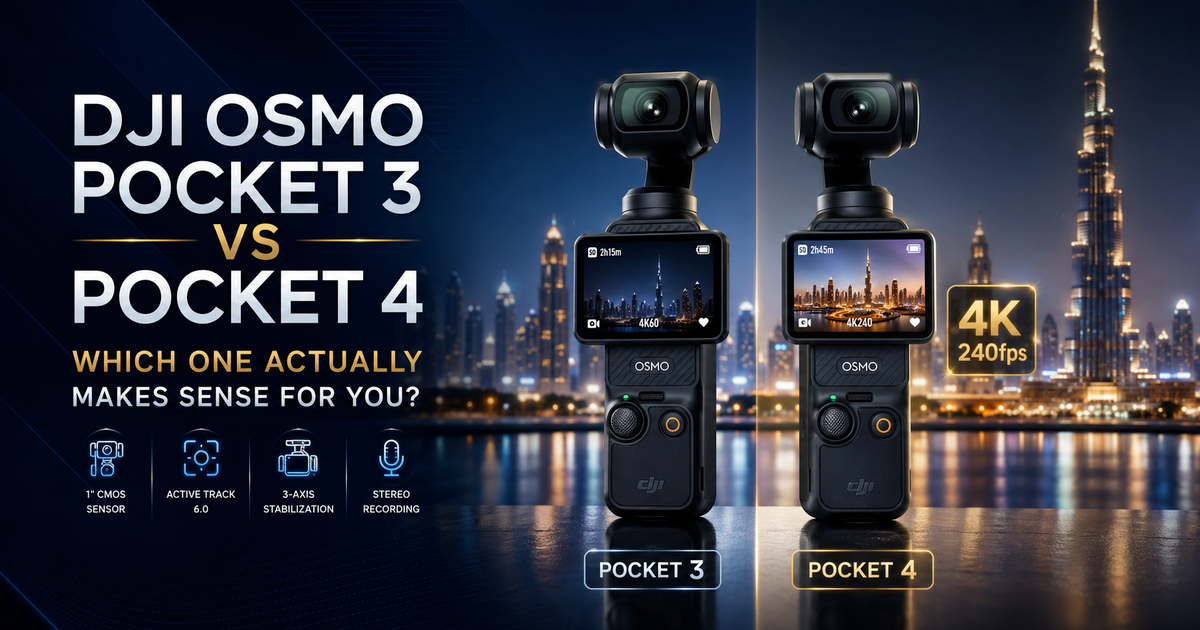
At first glance, it seems like a simple decision: newer model equals better choice, especially in April when many new releases hit the market.
But in reality, most buyers don’t need “the latest.” They need the right tool for how they actually create content.
This guide will help you understand what really changes between the two, which upgrades actually matter in real use, and whether waiting is worth it or not.
Start Here: Should You Buy Now or Wait?
Before diving into technical differences, let’s simplify the decision.
Buy the Osmo Pocket 3 if:
- You want to start creating immediately
- Your content is mostly vlogs, travel, daily use
- You prefer a proven, stable camera
- You don’t spend much time editing footage
Wait for the Osmo Pocket 4 if:
- You’re serious about video quality and creative control
- You use slow motion, color grading, or cinematic edits
- You want a smoother long-term workflow
- You’re upgrading from an older device and want a bigger leap
What Actually Changes (Beyond the Specs)
On paper, the differences look technical. In real life, they come down to three things:
- More creative control
- Better performance in difficult conditions
- Faster, smoother workflow
Everything else is refinement.
Image Quality: Noticeable or Not?
Both cameras use a 1-inch sensor, which already puts them ahead of most compact cameras.
So the question isn’t “is Pocket 3 good?” It is.
The question is: Does Pocket 4 give you more flexibility?
Where the Pocket 4 improves:
- Handles bright and dark areas in the same shot more smoothly
- Preserves more detail in shadows and highlights
- Produces cleaner footage in low light
What that means for you:
- Better sunset and outdoor contrast shots
- Cleaner indoor footage
- More usable clips without needing perfect lighting
When this matters:
- Filmmakers
- Content creators who edit heavily
- Anyone aiming for a more cinematic look
When it doesn’t matter as much:
- Casual users
- Simple vloggers
- Quick social media content
Video Capabilities: More Than Just Frame Rates
Yes, the big number is:
- Pocket 3: 4K at 120fps
- Pocket 4: 4K at 240fps
What 240fps actually gives you:
- Ultra-smooth slow motion
- More dramatic storytelling
- Cleaner motion breakdown (great for action or product shots)
If you’re filming walking shots, you won’t notice much difference. If you’re filming action, movement, or transitions, you absolutely will.
This upgrade is powerful, but only if you use it intentionally.
Color & Editing Flexibility
This is one of the biggest hidden differences.
The Pocket 4 introduces a stronger color profile (10-bit D-Log), which means:
- Ability to adjust colors without losing quality
- Improved brightness for better visibility
- More user-friendly touchscreen interface
- Greater consistency across clips
If you’ve ever tried to fix overexposed footage, wanted a cinematic color look, or matched clips from different scenes, you’ll feel the difference immediately.
But here’s the reality:
- If you don’t edit much, post directly to social media, or prefer quick content creation, then this feature won’t change your experience much.
Tracking & Ease of Shooting
This is where the Pocket 4 becomes noticeably more convenient.
With improved tracking:
- The camera follows subjects more accurately
- Focus stays consistent even with movement
- You spend less time adjusting settings
For solo creators, this is huge.
You can set the drone camera down, move naturally, and trust that it keeps you in frame.
Add gesture control, and you don’t even need to touch the camera to start recording.
This isn’t just a feature. It’s a workflow improvement.
Audio: A Subtle Upgrade That Matters More Than You Think
Most people underestimate audio, until they hear the difference.
The Pocket 4 improves audio by:
- Recording multiple audio sources separately
- Adjusting sound based on zoom
- Better integration with wireless microphones
What this means in practice:
- Clearer voice recording
- More immersive sound
- Easier editing later
If your content includes talking, interviews, or narration, this upgrade adds real value.
Workflow Improvements: The Hidden Advantage
Key improvements:
- Built-in storage
- Faster file transfer
- Better connectivity
You spend less time setting up, transferring files, and managing storage. And more time shooting, editing, and publishing.
For frequent creators, this is a daily quality-of-life upgrade.
Design & Portability
Both cameras are built for the same purpose: capture high-quality footage anywhere, instantly.
The Pocket 4 is slightly heavier, but still pocket-sized, travel-friendly, and quick to use.
What improves:
- Brighter screen (easier outdoors)
- More physical controls
- Faster interaction
These are small changes, but they make the camera feel more refined.
Price & Value in the UAE
This is where your decision becomes practical.
Osmo Pocket 3:
- Lower price
- Available now
- Excellent for most users
Osmo Pocket 4:
- Higher price (expected)
- Better for advanced creators
- More future-proof
Smart buying tip:
If you’re in the UAE, consider creator combo bundles, warranty from official retailers, and whether you’ll use advanced features.
Paying more only makes sense if you’ll use what you’re paying for.
What Most People Overlook
The biggest mistake buyers make is simple: they choose based on specs, not usage.
Ask yourself:
- Do I actually edit my videos?
- Do I shoot creatively or casually?
- Do I need this now, or can I wait?
Final Decision: Keep It Simple
Here’s the clearest way to decide:
Choose the Osmo Pocket 3 if:
- You want something reliable, capable, and ready today.
- It covers vlogging, travel, everyday content, and social media very well.
Choose the Osmo Pocket 4 if:
- You want more control, more flexibility, and a more advanced tool.
- It’s better for cinematic content, professional use, and long-term creative growth.
How does battery life differ between the Osmo Pocket 3 and Pocket 4?
When it comes to battery life, both the Osmo Pocket 3 and Pocket 4 offer impressive performance, but there are subtle differences worth noting.
The Osmo Pocket 3 boasts a solid battery life that comfortably supports extended shooting sessions, typically lasting around 140 minutes on a full charge during standard usage. This is more than adequate for casual users who might be vlogging or capturing memorable travel moments without the constant need for recharging.
Is the DJI Osmo Pocket better than a GoPro?
The DJI Osmo Pocket excels in portability and ease of use, offering 3-axis stabilization and high-quality 4K video. However, GoPro models are renowned for their ruggedness and extensive accessories. The choice between them depends on your specific needs: compact filming or extreme sports versatility.
Final Thought
This isn’t about “better camera.”
It’s about which one fits how you create, right now.
Because the best camera isn’t the newest one. It’s the one you’ll actually use, confidently and consistently.
Ready to buy? Shop DJI Osmo Pocket 3 Creator Combo.